Funktionales Jonglieren: Grundlagen

In this course on "Functional Juggling: Foundations," you will explore the basics of rhythmic juggling through a series of engaging ... Mehr anzeigen
Kursleiter
Marc Bielert
0
0 Rezensionen
  • Beschreibung
  • Lehrplan
  • FAQ
  • Bewertungen
  • Grade
Funktionales Jonglieren: Grundlagen

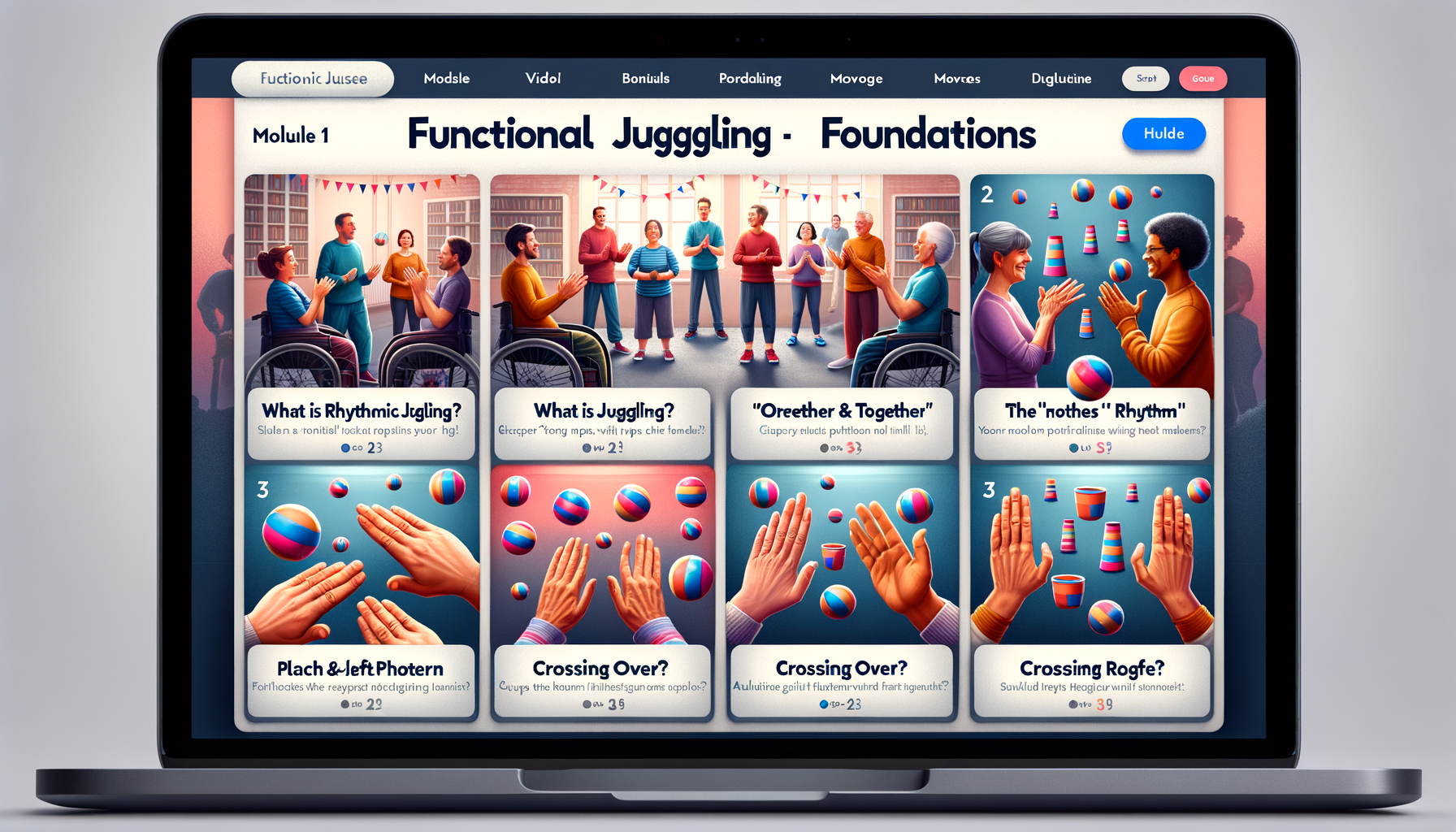
Proposed Course Structure: “Functional Juggling: Foundations”

Module 1: What is Rhythmic Juggling?

  • Goal: Sell the feeling and the why.
  • Content: A dynamic intro showing diverse people (ages, abilities) doing patterns with cups, their hands, balls. Voiceover focuses on fun, focus, and flow. State explicitly: “You don’t need any special equipment to start.”
  • Key Message: This is about finding your flow, not about difficult tricks.

Module 2: Pattern 1 (“Columns”) & The “Together” Rhythm

  • Goal: Teach the simplest pattern in the simplest rhythm.
  • Step 1: The Rhythm. Start with just hands. Clap the pattern. (Sync Lateral).
  • Step 2: On a Table. Use hands to tap the 2-3 and 4-5 locations.
  • Step 3: With Objects. Use cups. Turn them up/down.
  • Step 4: On the Juggle Board. Finally, show the “official” version.
  • Wrap-up: “You’ve just learned the ‘Together’ rhythm. Notice how your hands are moving like a mirror.”

Module 3: Pattern 1 (“Columns”) & The “One-Two” Rhythm

  • Goal: Show how changing the rhythm transforms the pattern.
  • Content: Repeat the steps from Module 2, but now with an alternating rhythm (Async Lateral). Start with tapping right-left-right-left.
  • Wrap-up: “Same pattern, new rhythm! This is the ‘One-Two’ rhythm. Feel the difference?”

Module 4: Crossing Over – The “Together & Crossing” Rhythm

  • Goal: Introduce bilateral movement.
  • Content: Take a simple pattern like Pattern 4 (“The Cross”) and apply the Sync Bilateral rhythm. Use scarves or hands first to make the crossing motion feel safe and easy.
Was ist das Ziel des Moduls 'Rhythmische Jonglage'?
Das Ziel ist es, das Gefühl und den Zweck hinter rhythmischer Jonglage zu vermitteln, indem verschiedene Menschen in verschiedenen Altersgruppen und mit verschiedenen Fähigkeiten Muster mit Tassen, Händen und Bällen zeigen.
Welches Muster wird im Modul 2 'Säulen' gelehrt?
Im Modul 2 wird das einfachste Muster mit dem einfachsten Rhythmus gelehrt, beginnend mit dem 'Zusammen'-Rhythmus und der Säulenmuster.
Wie verändert sich das Muster im Modul 3 bei Veränderung des Rhythmus?
Im Modul 3 wird gezeigt, wie sich das Muster ändert, wenn der Rhythmus von synchron zu asynchron wechselt. Es wird der 'Eins-Zwei'-Rhythmus eingeführt, wodurch das Muster eine neue Dynamik erhält.
Was ist das Ziel des Moduls 4 'Überschneidung - Der 'Zusammen und Überkreuz'-Rhythmus'?
Das Ziel ist es, eine bilaterale Bewegung einzuführen, indem einfache Muster wie 'Das Kreuz' mit dem synchronen bilateralen Rhythmus geübt werden, um die Überkreuzbewegung sicher und leicht zu gestalten.
Grade details
Kurs:
Student:
Enrollment date:
Course completion date:
Grade:
Grade Points
Grade Range
Exams:
Sign in to account to see your Grade